 You could make a day of it by visiting the Harlingen Arts and Heritage Museum and then, just a hop, a skip, and a jump away, is the Iwo Jima Monument and Museum at the Marine Military Academy.
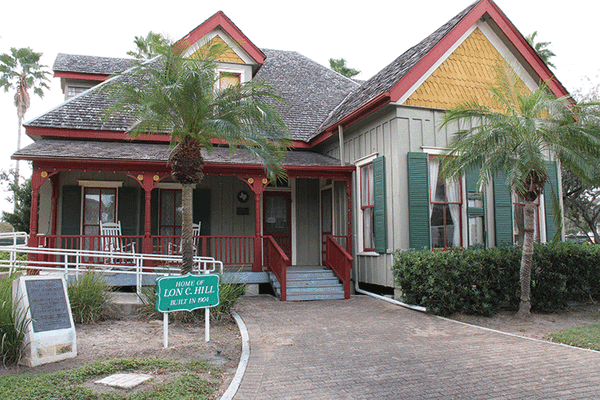
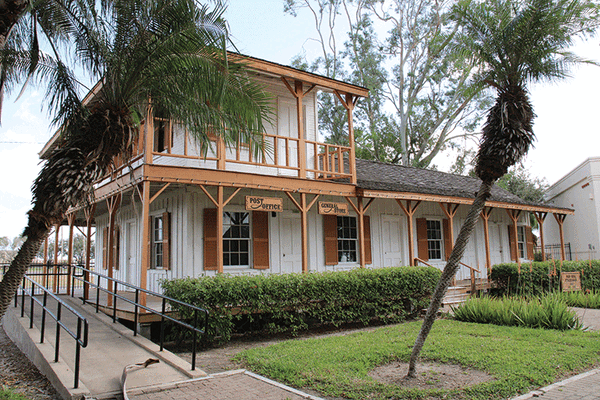
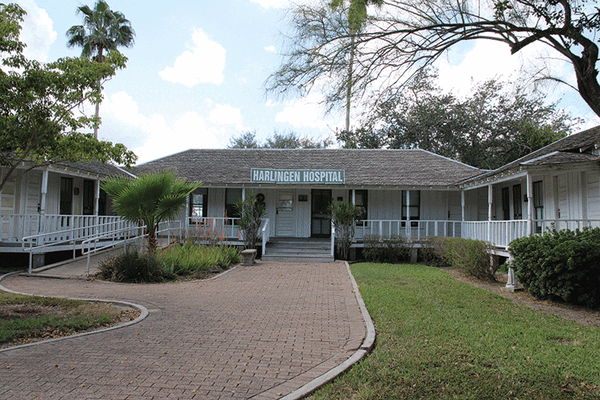
The Harlingen Arts and Heritage Museum is a one-of-a-kind museum in the Rio Grande Valley. The museum houses three historical buildings on its ground. When you visit the museum, you will also be able to look at the original home of Lon C. Hill, Harlingen’s town founder; the Paso Real Stagecoach Inn; and Harlingen’s first hospital.
Also on the grounds is the Historical Museum, formerly the Air Police Squadron and Brig of the Harlingen Air Force Base. This building houses a permanent collection of Harlingen and Texas historical objects and photos.
The main museum building features rotating arts and cultural exhibits.
A bit of history – Lon C. Hill was a true pioneer and one of the most forceful characters according to some who knew him. He was never known to dodge a fight – whether it was the six-shooter route, a legal courtroom battle, or the type of political battle that was common to the Rio Grande country of Texas over a hundred years ago.
In the early days, the town was called Six-Shooter Junction. This was due to the fact that its first Anglo-Saxon population consisted mostly of Texas Rangers, Border Patrolmen, and Hill.
The City of Harlingen was founded in 1904 by Hill – and his home was the first residence in the area. Soon, Six-Shooter Junction, was no longer that – it became a city with modern office buildings, hotels, and more.
 He showed those who questioned his thinking, that the Valley would be a prosperous area, that the river could be tamed, and there would be gardens. He built the region’s original irrigation canals that are gravity-fed. This set the stage for farming that eventually became the mainstay for the area economy.
April 15, 1910, is marked as the official founding of Harlingen when there was an official oath of office, a mayor and a commissioner, and the first city meeting was held.
All of this history, and more, can be found on the City of Harlingen’s website at https://harlingentx.gov/community/history.php.
The museum chronicles this history with artifacts from the period, and of course, Hill’s home. When I visited a while back, they had an exhibit that featured antiques from the days of yore and the days of farming with less technology than we have today. They were having a little contest to see who could name each ‘artifact.’ I can tell you, with a farming background and from watching many old movies, I could name nearly every piece they had on display.
Right now, they have their annual Christmas Extravaganza. A Christmas tree exhibit showcasing trees decorated by local organizations. There will be an official opening ceremony on Thursday, December 11. The grounds will also be decked out in holiday decorations, making for some beautiful photos. It will be on display until December 31.
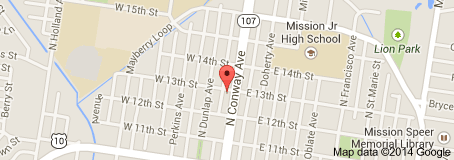
 Harlingen Arts and Heritage Museum hours of operation are 10 a.m. to 4 p.m., Tuesday through Saturday; and Sunday from 1 to 4 p.m. The museum is closed on Mondays and major holidays. Guided tours are $2 for adults, and $1 for children. The museum is located at 2425 Boxwood Street.
About a mile away from the museum is the Iwo Jima Memorial Monument. The monument sits on the campus of the Marine Military Academy.
The outdoor sculpture is the original work of art created by Dr. Felix W. De Weldon, a sculptor serving in the Navy at the time of the war. This sculptor was the model that was created to make the bronze sculpture in Arlington National Cemetery. It was given to the Marine Military Academy in 1981.
The memorial depicts the six Marines shown in a Pulitzer Prize-winning photograph as they struggled to plant an American flag atop Mount Suribachi on the Pacific Island of Iwo Jima on February 23, 1945. The island had been taken by the Japanese in the early years of the war, and the planting of the flag was a symbol to the free world of the struggle going on in the Pacific to preserve freedom.
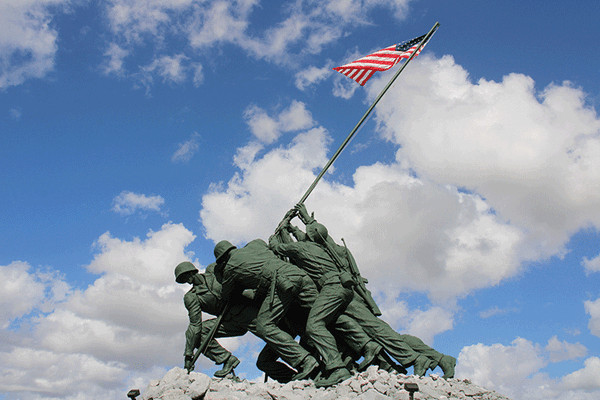 Harlon H. Block, a Weslaco native, was 18 years old when he enlisted in the Marine Corps. On the fifth day of battle on the island of Iwo Jima, his platoon was sent to raise that flag on the island’s highest point. The flag raising was captured by Joe Rosenthal. Block was killed on Iwo Jima six days after that flag raising. In 1995, during a ceremony commemorating the 50th anniversary of the battle, Corporal Harlon H. Block was enshrined next to the Iwo Jima Memorial.
There is also a museum on the grounds that features Marine Corps memorabilia and a veteran’s hall of fame. For more information about the monument, visit their website at www.mma-tx.org/about-us/iwo-jima-monument/.
You can visit the memorial at 320 Iwo Jima Blvd.