 By Barb Zanetti
Photos by Dennis Zanetti
Editor's Note: The first half of this story appeared in our March 25, 2026 print edition. If you have already read the first half, and want to jump to the second half, CLICK HERE.
A ‘Classy Quilter’ Teacher Who’s Making a Difference
Joining forces with others, Elaine Snyder helped Alamo Palms Resort and its Classy Quilter group become one of the top in the Valley – one quilter at a time.
Many say it’s her welcoming efforts and those of other experienced quilters that are responsible for more than tripling the number of park quilters to 65.
Elaine believes the projects the park’s experienced quilters choose and the way they teach it makes all the difference.
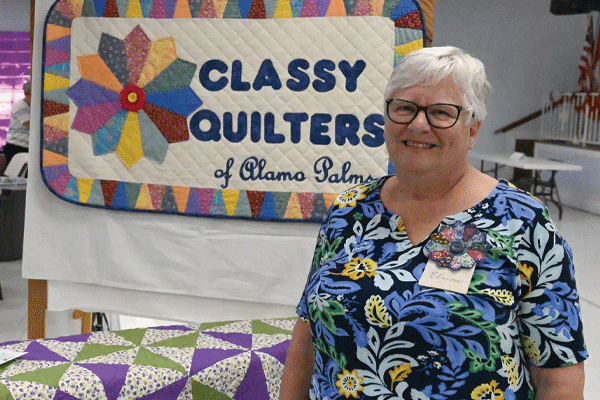 “I like offering classes for beginners to experts,” Elaine says about the 10 different one’s seasoned quilters led this year.
She says if she teaches them to make a special block, the quilters have choices of how and what they’d like to do with them such as creating a starter project like a wall hanging or a table runner.
However, the key to getting and keeping so many new quilters interested is that Elaine never wants them to feel alone or that they’re “not good enough.” She insists that seasoned Classy Quilters sit beside the newest quilters, so they don’t fall behind or get discouraged.
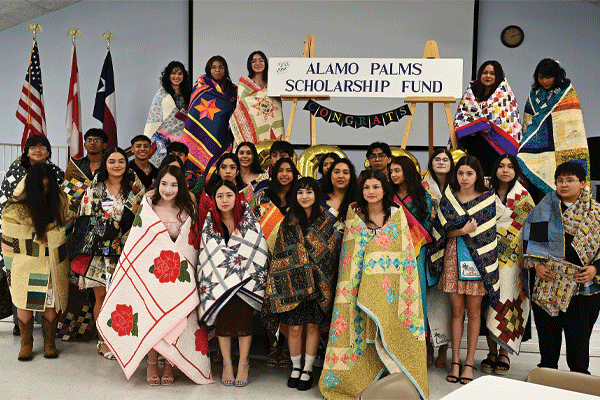
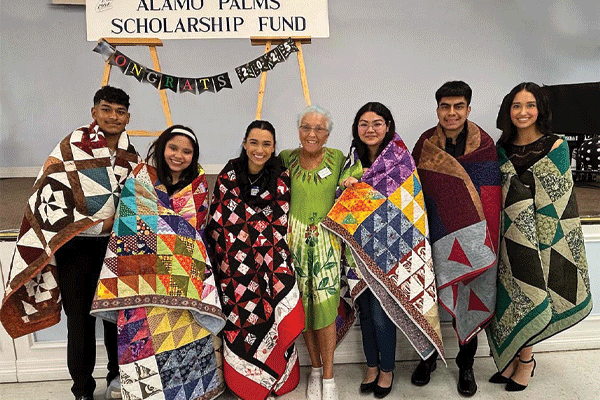
With Elaine’s mantra that “everyone starts somewhere,” she encourages all quilters to learn and become aware of the many donation opportunities available to park quilters – especially the scholarship quilts, which are presented annually to Alamo high school’s (PSJA) scholarship winners.
In addition to the 28 long-arm scholarship quilts that Alamo Palms quilters donated this year, each of the students receives an award of $1,000 (once they’ve been enrolled in a college or tech school program).
Some feel these teens may value their quilts more than the money.
Elaine says their school counselor told her “These kids [wrap themselves in the quilts and] carry them close. It’s like a prized award. For some, it’s the first thing they’ve ever owned. And they love them!”
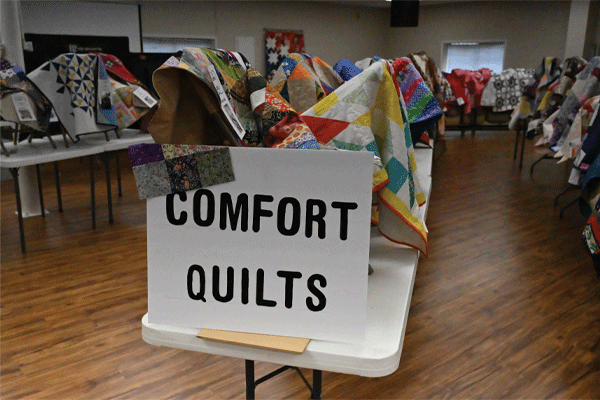
Another area that many donate their handiwork to is Comfort Quilts, which go to Winter Texans who’ve been hospitalized for extended periods.
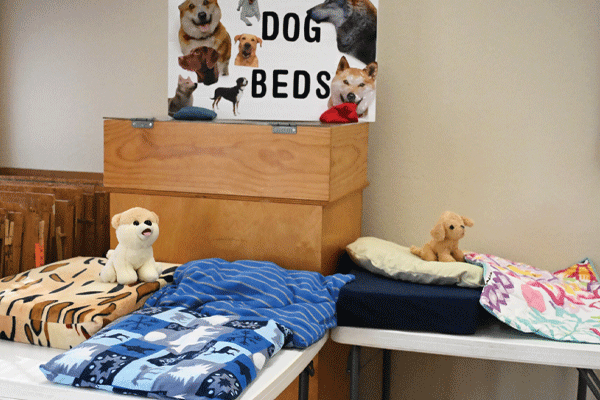
Newer opportunities for park residents interested in sewing and donating include beds for rescue dogs (led by Annie VanDamm, who completed 100 of them this season). Additional items, such as bibs and baby blankets, are being donated to a doctor’s office to encourage pregnant moms to come in for their scheduled health checks.
Quilting for Comfort
After a family tragedy, a friend introduced Elaine to quilting. That hobby became such a comfort to her in the first year that she surprised herself and her family by making six quilts – giving those to her siblings – and then making two more for her parents. “They were shocked that I did so much, so fast!”
Now, a lot of the quilts she makes go to charity.
“If I know the person receiving my quilt, I tend to think about that person and their life while I’m sewing it,” she says. “However, the Scholarship Quilts are different. For them, I’m thinking … ‘I hope the teen likes it, appreciates it.’ I know they will because the scholarship money and quilt put them on the road to a better life … a solid career.”
She realizes the twin-sized bed quilts the students get take time.
“For me, the most important skill to making any quilt is dedication,” she says. “A bed quilt is not something most of us can make in a day. It can easily take six months. So, it demands dedication to keep it going for all that time while your life is speeding by.”
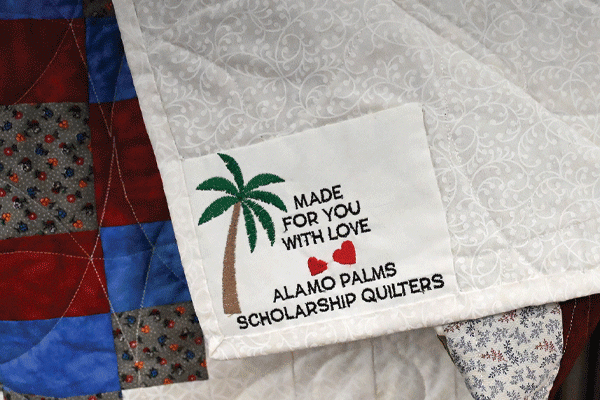 Elaine explains that one of the biggest misconceptions that quilt recipients have is the expense and time invested. It adds up due to long-arm charges (by the inch), the quilt-top fabric, the batting (filler material), and yards of backing material, along with pricey special thread, patterns and rulers. Each twin-sized quilt can easily cost over $100 for the long-arm quilting alone.
“We’re kind of conditioned to deal with the expense,” she says. “The truth is … If you want to do this, you just have to pay the money.”
It’s worth it, according to Elaine. She feels gifting the quilt is rewarding and wants every quilter’s story told.
“Before every quilt show, I push my quilters to tell me the story of their quilts,” she says. “Why did you choose this? What was difficult about making it? Who is this for? And why?”
However, what isn’t told on the attached labels are the stories of the quilters’ lives themselves – like Elaine’s and the growing group of generous Winter Texans, who have positively changed Alamo Palms Resort.
A Quilting Machine’s Resistance
 Julie Perry’s mom was an avid seamstress, a perfectionist, one who sewed everything her family needed. A typical teen, Julie says she was “turned off” to even the idea of sewing.
But life changed for her when she married and started making maternity clothes, curtains and basic blankets – but never a quilt.
It was after she began selling her old-fashioned rag rugs at craft shows that she learned about making Quillows (small quilts that fold into a pillow). It wasn’t until the 90s when she spotted the revolutionary rotary cutter and mat, which intrigued her so much that she found herself “addicted” to quilting.
She says the main reason she avoids quilting in groups is that “a quarter-inch seam to me is not a quarter-inch to others. So, you get everybody’s blocks and they don’t match up. If I’m a little off, and I’m off all the way through, I can blame myself.”
Many call Julie a “quilting machine.” She says it could take her a day to make a quilt. Maybe a week. Or a month. It just depends on the design. How easy it goes together. How much time she has each day to do it.
“Sometimes I can work two hours a day,” the seasoned quilter says. “Some days more. Some days less. And as I’m getting older, my body doesn’t like for me to work too long at one time. I’m 86.”
One of her focuses is teaching quilting, helping new quilters learn the basics.
“You really need math because it helps you figure out whether the blocks will fit,” she says, explaining the challenges of making a design work.
But she’s not a perfectionist. Her mantra? “A finished quilt is better than a perfect one that never gets done.” And once it’s finished, she wants the recipient to use it but never refer to it as a blanket.
For her, quilting can be healing… “You have to concentrate on quilting,” she says, “so it takes your mind off what is bothering you.”
When her husband passed away three years ago, she created over 20 pillows out of his shirts. The front buttons on his shirt became the buttons on the back of the pillow, so it was easy to wash by unbuttoning it and removing the pillow form. On the front of each of them was a pocket.
“It was probably the only memorial service where everyone got a gift,” Julie says. “I made them for all my kids and my grandkids. It was therapeutic for me.”
To afford the cost of donating quilts, she tries to be thrifty in all aspects of her life, whether it’s food, clothes or other areas of her living.
“I was raised that way,” she says. “It’s like inbred. That’s the way I roll!”
She credits thriftiness for having made it possible to donate six quilts to the Scholarship Quilts last year and six more this year. She insists that each one of those quilts deserves her label.
“Every one of my quilts has my name on the quilt: “Made With Love by Julie Perry for (and then a blank).” It also says ‘2026’ and the size of the quilt. At the presentation of the quilts, I have my pen with me. Either I write the student’s name on that label or they do. Then, I gather all the students who have my quilts and have them take a picture with me.”
At the reception after presenting the quilts, she says she likes to talk to the teens. If she made a hunting quilt for a boy, she’d tell him that when she made the quilt, she was thinking of a person like him. … Someone who was interested in the outdoors.
What Julie wouldn’t tell him was that all the time she was making it, she kept reminding herself that, in her heart, she knew “he’d love it!”
 Never Wanting To Make a Quilt
An accomplished quilter, Beverly Sutton’s mother tried to get her to make one. Even after her mom suggested working on a quilt for Beverly’s married daughter Kristen, Beverly continued to say no.
But she did agree to go with her mom to choose a pattern and the fabric.
Then Beverly’s mother went home to cut and stitch until the fabric’s soft colors became an exquisitely beautiful quilt top.
Blaming her mother, and unsure how the woman had managed it, Beverly found herself blurting out that she “wanted to quilt it, to hand quilt it, for Kristen, that is” … which was something she had never done.
It wasn’t long before her living room was filled with two sawhorses topped by a large quilting frame that secured all of it – the beautiful top, the batting and the backing. Once everything was in place her mother gave her a lesson on stitching the three layers together – tiny stitches – straight – and extremely regular.
The large contraption sat in Beverly’s living room for five years – with the frame propped against the living room wall whenever she needed room. It was a fellow teacher who shamed Beverly into finally finishing it.
Once done, on the back of the quilt, she embroidered: For Kristen by Grandma Henry. Quilted by Beverly Sutton (Mother).
But she still had never made a complete quilt – not until she came to Alamo Palms Resort.
It all started the day she went to a show, saw a quilt that featured shades of pink, and fell in love with it. She asked the quilter for the pattern and finished it – her first one. A prized quilt that she keeps displayed on a shelf. Since that first one, the accomplished quilter has made at least three dozen more.
Beverly’s quilts, like her mother’s, are exquisite, according to her fellow Classy Quilters.
She says she’s not sure how that happens, but she realizes that she has a “creative bent.” So, when she considers a quilt project, it’s the pattern that excites her first. When she finds the perfect fabric, she’s on her way to a finished quilt. And that excitement stays until she’s done. She says, “I just love it all!”
“I’m always proud when I’m finished,” Beverly says pointing to one skill that often sets her apart – the precision of her corners.
“No matter how beautiful a quilt is, I never feel a letdown after I finish a project. And I have no desire to make a second quilt from that pattern.”
After gifting them to family and friends, she started donating them – one to the Scholarship Quilts and then helped on a Veterans Quilt. And now she’s looking forward to doing more.
Beverly feels that the quilt giving of her fellow quilters is due to “their generous hearts.” Yet, she admits that the truth might be a need to donate due to their “love of quilting.”
Whichever it is, is fine with charity groups that receive the benefit of her own “generous heart.”
 A Story of Perseverance
After talking to quilters from a small Winter Texan park about how they honored their veterans, Nancy Steppke, a retired nurse, says she was distraught.
“I can’t sleep at night because I think there’s more that can be done for the veterans in our park,” Nancy says she told fellow quilter Cindy Biggerstaff. “We need to do more to show that we care about the veterans in our park community. And we need to do this right away!”
It wasn’t long before she found the enthusiasm she was hoping for.
“The day Cindy agreed to help and volunteered to complete the long-arm quilting for free,” Nancy says, “I was on Cloud Nine.”
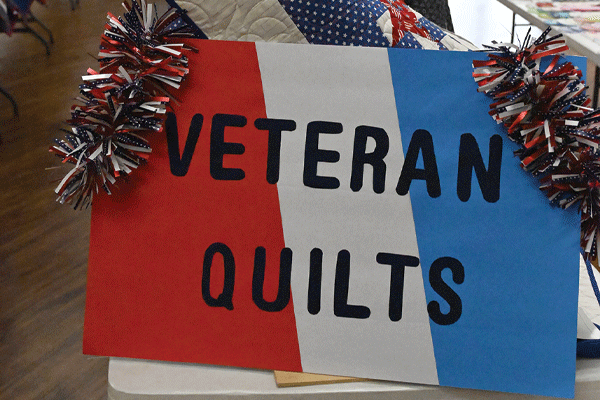
The excited quilter said she was grateful to have someone in the park help to bring her idea to life. That meant organizing a sizeable group of volunteers to sew red, white and blue quilt tops, get batting and fabric backing – and to plan a dinner and a program to honor Alamo Palms’ veterans.
As Nancy and Cindy’s plan evolved, they decided to gift the oldest veterans with the first 22 of the planned 52 quilts at a program honoring all branches of service, followed by a sit-down dinner where all veterans ate free.
This season at the second dinner/program, 18 veterans were presented with a quilt.
This year’s program was a touching reminder that most veterans don’t talk about their experiences unless people care to ask, according to Nancy.
“The one veteran that broke my heart started to cry when he revealed that he had been assigned to Arlington Cemetery to bury the dead,” Nancy says. “He saw a lot.”
Next year, the remaining 12 quilts will be presented – although more will be made if veterans move into the park – for a minimum of three months.
Nancy Steppke says she didn’t start quilting until she came to Alamo Palms and took some Classy Quilter classes. Just little projects at first. And then she started stitching little throw quilts. That progressed to more complicated patterns and before she knew it, she said she was making larger and larger quilts.
“When our son died, I was confident enough to make a memory quilt with his t-shirts. … Queen-sized,” she says proudly. “And the following year for our grandson, I made a queen-sized denim quilt out of his father’s Harley Davidson and work blue jeans.”
Although she finished the project earlier, she waited until time passed – two years – to give her grandson the quilt because she didn’t want to make him sad.
“These two quilts helped me grow [as a quilter],” she says. “So now every project I work on must be meaningful – especially those I gift.
 A Path from Beach to Retreat to Tele-Quilting
Being introduced to quilting in California led Peggy Fleming to ocean beaches, where she camped and sewed with friends who shared her quilting fascination. And that led to them attending quilting retreats – a unique togetherness.
And as she learned more from fellow quilters, she grew to love her hobby.
Summers now find her on the road – sharing her camper with her husband Mike, two dogs and a sewing machine, along with enough equipment to handle her basic quilting needs.
Winter finds her finishing her quilts in her “she shed,” set up to handle larger quilts. It’s there that on Sunday afternoons, she’s on Facetime calls with her friend Bertie, who, too, has moved several times since they once sewed together in person on California beaches.
For now, it’s a glass of Doubleback Cabernet Sauvignon for Peggy, a Wild Turkey Honey Bourbon drink for Bertie, a propped-up phone or computer and hours of conversation – until it’s time to cut. It’s then that all talking ceases. The rotary cutter comes out. And the serious and un-redo-able part of their projects takes priority.
When the pieces are ready, their tele-quilting conversation continues. They’re connected. They talk about fabric – their color choices, new techniques, their progress… And when they’ve spent enough time together, Bertie may have finished a Quilt of Valor. Peggy may have put the final touches on a Breast Cancer, Scholarship or Veteran quilt.
Whether they’re together because of their quilting love or addiction – for sure, it’s a unique long-distance friendship. Two quilters sharing their craft and doing good like so many at Alamo Palms … classy quilters, indeed.